May 28, 2026
You wash it every week. You dry it carefully. Maybe you even vacuum the inside.
But here’s something most car owners in Dubai don’t realise — washing your car and restoring your car are two very different things.
That dull, hazy film sitting across your bonnet? That faint web of swirl marks you notice when sunlight hits at just the right angle?
What your car actually needs is a polish.
And if you’ve never had it done — or worse, had it done wrong — your paint has been quietly suffering this whole time. Let’s mend that.
We understand. Dubai life is busy. You wash your car, it looks nice, and that seems to be sufficient.
However, what is truly going on inside is quite different.
There is a very slight protective layer on your car’s paint, which is known as the clear coat. This is responsible for the glossy and mirror-like appearance. And in Dubai, that clear coat is under constant attack from:
All of this accumulates as time goes by. The paintwork becomes faded, lifeless, and old-looking – this can even happen to fairly new cars. And the frustrating part? No matter how much you wash it, washing alone won’t fix it since it only helps in removing that dirt from the surface. It does not repair the damage below. It is in this area where car polishing fits in.
In simple terms, car polishing is a process of correcting the paint. It operates on the principle of applying mildly abrasive compounds to rub a microscopic surface of the clear coat in order to match the surface flaws and to give the paint its original lustre and clarity. Have it in mind this way – suppose your clear coat is a wooden floor. In the long run, it becomes scuffed and scratched. Smoothing is as though sanding, so that a smooth surface is exposed and the damage is removed. And to end, polishing, waxing, and washing are three totally different things:
Not all polishing is the same. The right type depends entirely on the current condition of your paint.
1. Cutting / Compound Polishing This is the heavy-duty option. Strong abrasives cut deeper into the clear coat to level out major defects. This one genuinely requires professional hands — too much cutting and you’ve damaged more than you’ve fixed.
2. Finishing / Glaze Polishing: Think of this as the refining step. After compound polishing — or for cars with only light surface marks — finishing polish uses ultra-fine abrasives to create a deep, glass-like gloss. It removes any haze left by the compound and prepares the paint perfectly for wax or ceramic coating.
3. One-Step / All-in-One Polishing: The time-saving option is efficient and suitable for well-maintained cars. One product washes, removes minor flaws, and puts on some light defense at the same time. Will not repair serious damage – but with a well-kept car, it will give a good, satisfactory job.
Here’s how professionals do it properly.
Step 1 — Wash and Decontaminate Thoroughly. Never polish a dirty car. Ever. Any dirt or sand on the surface becomes sandpaper as soon as you start polishing. Apply a pH-neutral automobile shampoo, rinse thoroughly, and dry thoroughly using clean microfibre towels.
Step 2 – Clay Bar: Put a plastic bag inside your hand over clean paint and run your hand. This sticky clay pulls out embedded contaminants that washing simply can’t reach — leaving the surface genuinely smooth before correction begins.
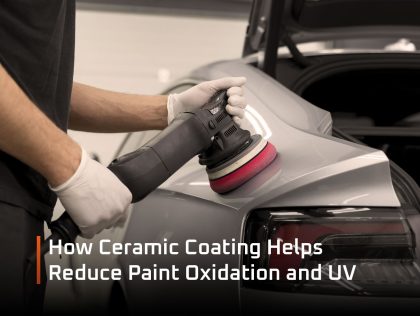
Step 3 — Choose the Right Polish and Machine Match your compound to the paint condition. For application, a Dual Action (DA) polisher is the professional go-to. Its random orbital motion makes it significantly safer than hand application and delivers far more consistent results.
Step 4 — Work Panel by Panel. Apply polish in small sections. Move slowly, with overlapping passes and light pressure. Allow the machine and the polish to do the work – do not force it. Rushing causes unsymmetrical correction and novel patterns of swirls.
Step 5 — Protect Immediately. Once this has been done, there is no second chance. Polishing peels off the old protective layer and reveals a new paint. Unless you wax it, seal it, or cover it with ceramic, then that newly fixed surface is in the full blast of the elements. Protect, dry, and fix the results.
Each polish removes a thin layer of clear coat. Over-polishing thins it out over time, which eventually causes more harm than good.
A sensible schedule for Dubai conditions:
Look — we’re not here to talk you out of caring for your own car. But when it comes to polishing, the margin for error is real.
Wrong pad, wrong compound, wrong pressure, wrong speed on a hot Dubai afternoon — and you can burn through the clear coat in seconds.
At Texas Pro Auto Detailing Dubai, we’ve worked on everything from daily city cars to high-end supercars. We assess your paint properly before we touch it, match the right compounds to your specific paint condition, and use professional-grade machines that deliver consistent, controlled results — every single time.
We’re not just detailers. We’re genuinely passionate about paint.
Now that you have lost the showroom shine on your car, you have been living too long with boring paint.
Come see us. We’ll take one look and tell you exactly what your car needs — honestly.
Your car deserves better than dull. And honestly? So do you.
Lorem Ipsum is simply dummy text of the printing and typesetting industry. Lorem Ipsum has been the industry's stan.

September 4, 2026
Why Dubai’s Climate Is Hard on Car Paint
May 30, 2026
How to Keep Your Car Cool in Summer
March 23, 2026
Common Car Detailing Mistakes That Can Damage Your Paint
February 16, 2026
Why Premium Detailing Adds Value Before Selling Your Car